
TL;DR: Yes. A professionally produced drone light show is one of the safest forms of aerial entertainment available. The aircraft are small, lightweight, and computer-controlled to the centimeter, they carry no fire and no explosives, and the whole flight is bounded by software that will not let a drone leave its assigned airspace. The real question is not whether drone shows are safe in general, but whether the crew flying yours is licensed, insured, and disciplined about weather and airspace. This guide shows you what to look for.
Direct answer: Drone light shows are safe when flown by FAA Part 107 certificated pilots operating under the proper authorizations, with geofenced flight paths, redundant fail-safes, and a rehearsed weather-and-abort plan. The safety comes from the process, not luck.
Why a drone show is inherently safer than fireworks
Picture the front row of your event. With fireworks, the thing making the spectacle is live combustion: heat, embers, shell fallout, and a concussive blast you feel in your chest. With a drone show, the thing making the spectacle is light. Each drone is a small aircraft, typically well under a pound, carrying an LED and a battery. There is no flame, no gunpowder, and nothing that falls burning out of the sky.
That single difference removes most of the hazards planners worry about. No burn-ban cancellation on 48 hours’ notice. No stray ember catching dry grass. No smoke drifting over the crowd. The drones fly a set distance from your audience, hold their formation by GPS, and land themselves when the show ends.
How the safety actually works
Safety in a drone show is engineered, not hoped for. A few systems do the heavy lifting.
Geofencing keeps every drone in its box
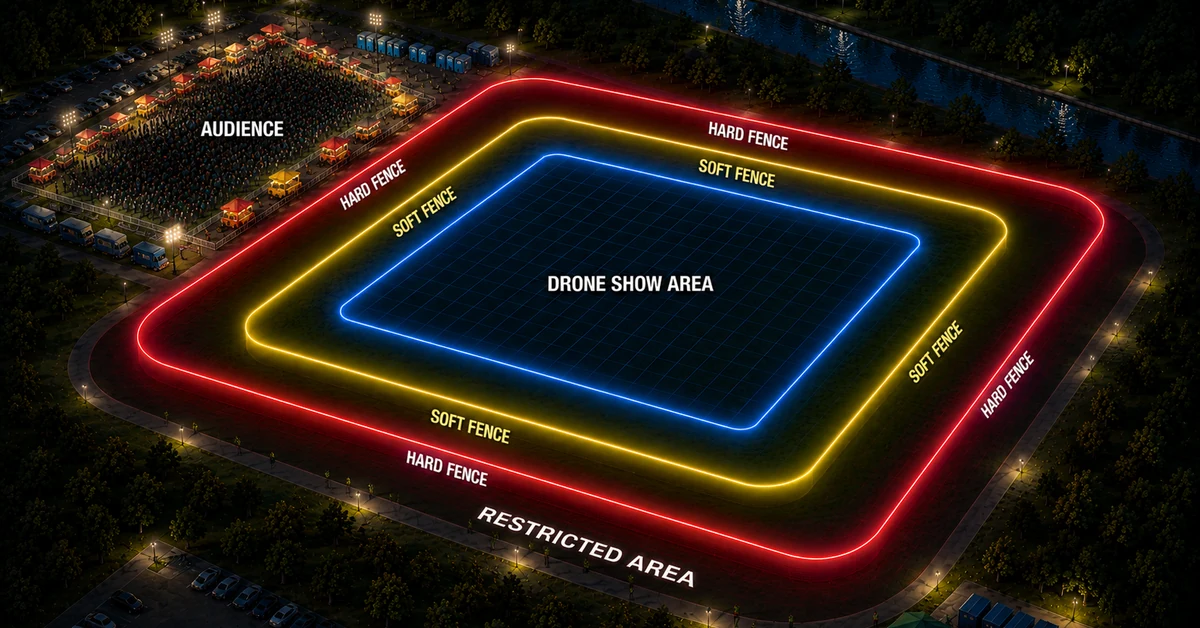
Before a single drone lifts off, the crew defines a three-dimensional volume of airspace for the show, a virtual box in the sky. Every drone is programmed to stay inside it. If a drone ever approached the edge, its software commands it to stop or return home. The audience sits well outside that box, with a safety buffer built into the choreography.
The flight is pre-simulated to the centimeter
The formations you see, the shapes, the logos, the animations, are all designed and simulated in software long before show night. Collisions are ruled out on a computer weeks ahead, not managed live. On the night, the crew is monitoring and ready to intervene, but the choreography itself has already been proven safe in simulation.
Redundancy and fail-safes
Professional show drones carry redundant systems and are programmed with fail-safe behavior. If a drone loses GPS lock, drops below a battery threshold, or loses its link, it does not wander. It executes a pre-set safe action, usually a controlled return-to-home or a controlled landing. The show is designed so that one drone having a bad night never becomes an audience problem.
What the FAA requires (and why it matters to you)
This is where professional shows separate themselves from hobbyists. Flying hundreds of lit drones at night over people is not something anyone can legally do off the shelf. It requires specific federal authorization.
A legitimate operator flies under a Part 107 certificate and holds the waivers that a light show demands, including authorization to fly multiple aircraft with one pilot and to operate at night. Flying near controlled airspace requires clearance on top of that. When you hire a crew, you are not just buying a show, you are buying their paperwork, their insurance, and their track record of doing this correctly.
If you take one thing from this article for your vendor conversations, make it this: ask to see their FAA authorizations and their insurance certificate. A real operator will have both ready. You can read more about how we handle authorizations and insurance on our safety page.
The weather call is part of the safety plan
Drones are precise, but they are still aircraft, and wind and rain matter. A disciplined crew sets clear weather limits in advance and briefs you on them before show day, so a go or no-go decision is never an argument in the dark. Light rain and moderate wind are often fine. Beyond the crew’s stated limits, a professional will delay or reschedule rather than fly a compromised show. That willingness to make the hard call is itself a safety feature, and it is worth asking any vendor how they handle it.
Is a drone show safe for all-ages, sensory-sensitive crowds?
Yes, and this is one of the quiet advantages of the format. Because a drone show is near-silent and produces no smoke or concussive blasts, it is far more accessible than fireworks for the people a public event is supposed to include: veterans with PTSD, autistic and sensory-sensitive attendees, young children, pets, and nearby wildlife. Safety is not only about the aircraft. It is also about who can comfortably be in the audience.
What to ask before you book
Use this as a quick screen for any drone show vendor:
- Can you show me your FAA Part 107 certification and the waivers you fly under?
- Do you carry liability insurance, and can I see the certificate?
- How do you geofence the show and buffer the audience?
- What are your published wind and weather limits, and who makes the go or no-go call?
- What happens if a single drone faults mid-show?
A crew that answers these clearly and without hesitation is a crew that takes the work seriously. Our own founder has spent ten years producing shows, and safety is the first conversation we have with every client, not the last.
The bottom line
Drone light shows are safe because the safety is designed into every layer: small non-combustible aircraft, geofenced airspace, pre-simulated choreography, redundant fail-safes, federal authorization, and a crew disciplined enough to say no to bad weather. The spectacle is in the sky. The risk, handled properly, stays on the ground. If you want to see what that looks like end to end, from the first planning call to showtime, here’s how a drone light show comes together.
Have a safety question specific to your venue or crowd? Ask us directly. We answer planner questions like these every day, and we would rather you feel certain before you book.